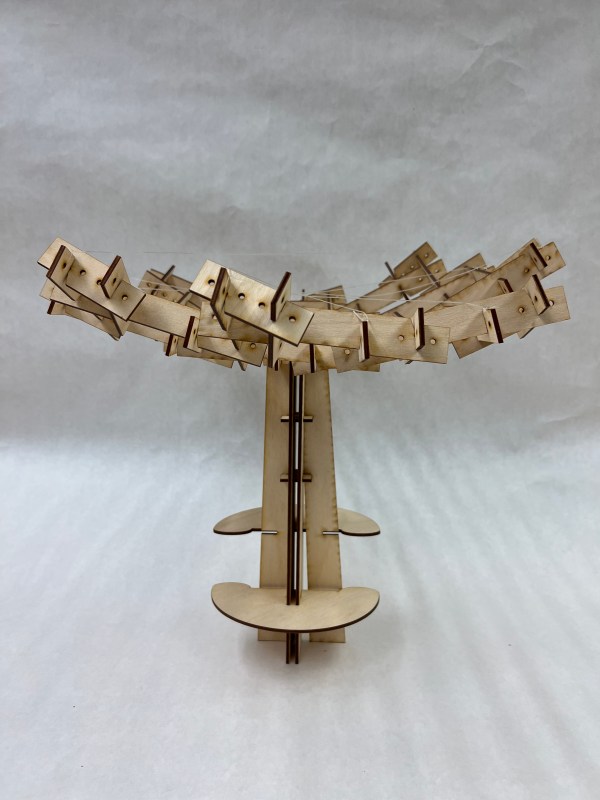
Case Study: RAW:almond Our design took a lot of inspiration from RAW:almond temporary restaurant pavilion in Canada. We reverse engineered to find the form of the single reciprocal frame element and study how the project was constructed. It help us in developing our frame research at a smaller scale. Design Process: Our approach to figuring... Continue Reading →
Team 3 Reciprocal Frame
We experimented here with variations in notches to create easier assembly. We also started looking at developing our vertical supports that reflect the same module pattern as the reciprocal frame. We adjusted the square footage to fit the 120 SF footprint and cut the members that were not supported enough on the edges. We will... Continue Reading →
Wave Hi to the Highland Park
Case Study From Reinforced Concrete to Plywood The case study that our assembly was based on was designed as a reinforced concrete structure. The beams were wider, rougher, and heavier than their wooden counterparts, which allowed them to rest effectively on top of each other. The wooden members did not behave this way. Their slender... Continue Reading →
The Architecture of Burning Man
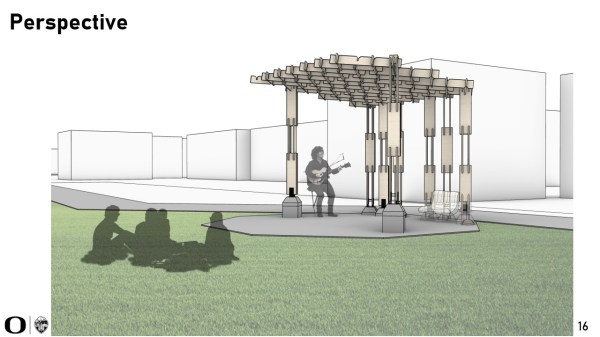
A nomadic system for continuous use and disassembly This design team successfully created a catalog of structures based on the same modular, reciprocal framing system. In the application of music festivals, the team designed a barrier, footbridge, small canopy and stage shell. Each of these installations have components that are adjustable, such as the cladding... Continue Reading →
Gazebo for Growth
https://player.vimeo.com/video/778299020?h=b70d8e3cca Additional Links: Midterm Progress | Fabrication Proposal For out final review we presented our model with connection optimizations made for simplified fabrication as we constructed a full scale model. These optimizations came from understanding the relationship of how the diagonal member notches into the horizontal member which was often causing compound angled planes on... Continue Reading →
The Star Gazer
From our initial development of ideas to the first and second design stages, material availability, CNC cut abilities lead our group to simplify out panel design to 12 members total. Physically building our design led us to learn about the complications of cut files and orientations of our model. We found that flipping out panel... Continue Reading →
Wooden Temple
This project focused on re-thinking wood in traditional construction. Traditional timber architecture in East Asia has been built with the column, beam, and strut systems with limited lengths of wood. The project began with the challenge; of how to cover a building with a wide-span structure while achieving a beauty that comes from the use... Continue Reading →
Star Gazer Canopy
The most important learning outcome in this design was learning how to use connections in order to combat forces. The thicknesses and types of connections we have at each of our member connection were decided because of the types of loads that they would combat. For example, the thicker outframe provided a stronger lateral load support as well as the connection piece to connect the frame. The major obstacle was trying to figure out what material is available to be able to be used to create our design and if our design could be supported by the material available. This was challenging because it limited our ideas and scale of what we wanted our design to be. However, we were able to come around this by creating an intimate space for people to be in. Our design was greatly praised for the simplicity of the pattern. The reviewers liked the pattern shape and how it is light and airy in the center. The greatest critique was to try and extend this pattern and feeling of airiness down into the walls of the canopy. They thought that the walls were too constricting about because the pattern itself is open, they wanted us to explore more of the openness down into the walls.
Coastal Grove Table
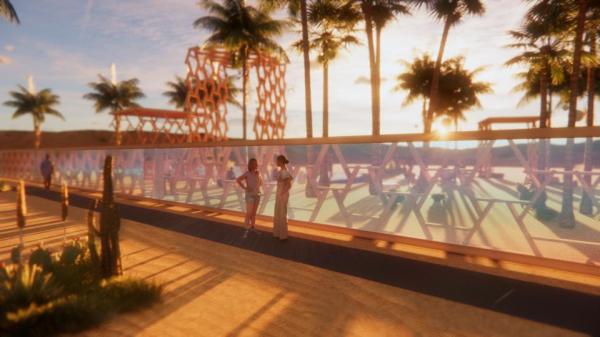
We initially set out to design an easily assembled, nomadic structure that would house various types of events on a beach setting. We created a reciprical system that could be scaled both horizontally as well as vertically, in order to meet the needs of various types and sizes of events. While the scheme itself was... Continue Reading →
Framed.
For this review, our team chose to focus on the presentation of our beautiful frame structure. The reciprocal frame could be used for a variety of applications, but we highlighted the bridge application as our constructable installation. We discussed the constraints of time and resources that led us to making some design decisions leading into... Continue Reading →